
How to Get More Patients from Google in 2026
Summarise this post with:
How to Get More Patients from Google in 2026
Local SEO & Patient Acquisition | 8 min read | For clinic owners, doctors & hospital administrators
If you want to know how to get more patients from Google, the short answer is this: combine a complete Google Business Profile, targeted Google Ads, ongoing SEO, consistent local listings, and active review management into one system. No single tactic carries a clinic on its own.
TL;DR
Most patients research a clinic on Google before ever calling.
A complete Google Business Profile is the highest-impact free visibility tool available to clinics.
Google Ads puts your clinic in front of patients who are already searching for care.
SEO is slower to build but keeps generating enquiries without ongoing ad spend.
According to Google, local rankings are determined primarily by relevance, distance, and prominence.
According to BrightLocal's 2026 survey, 97% of consumers read reviews before choosing a local business.
Two clinics can offer identical clinical quality and get completely different patient volumes, because patients aren't comparing outcomes before they book. They're comparing what shows up on the screen: visibility, reviews, photos, and how easy you are to contact. According to Google's own ranking documentation, local search results are determined primarily by three factors: relevance, distance, and prominence. Everything below maps directly onto improving those three factors.
Layer 1: Google Business Profile — Your Digital Front Door
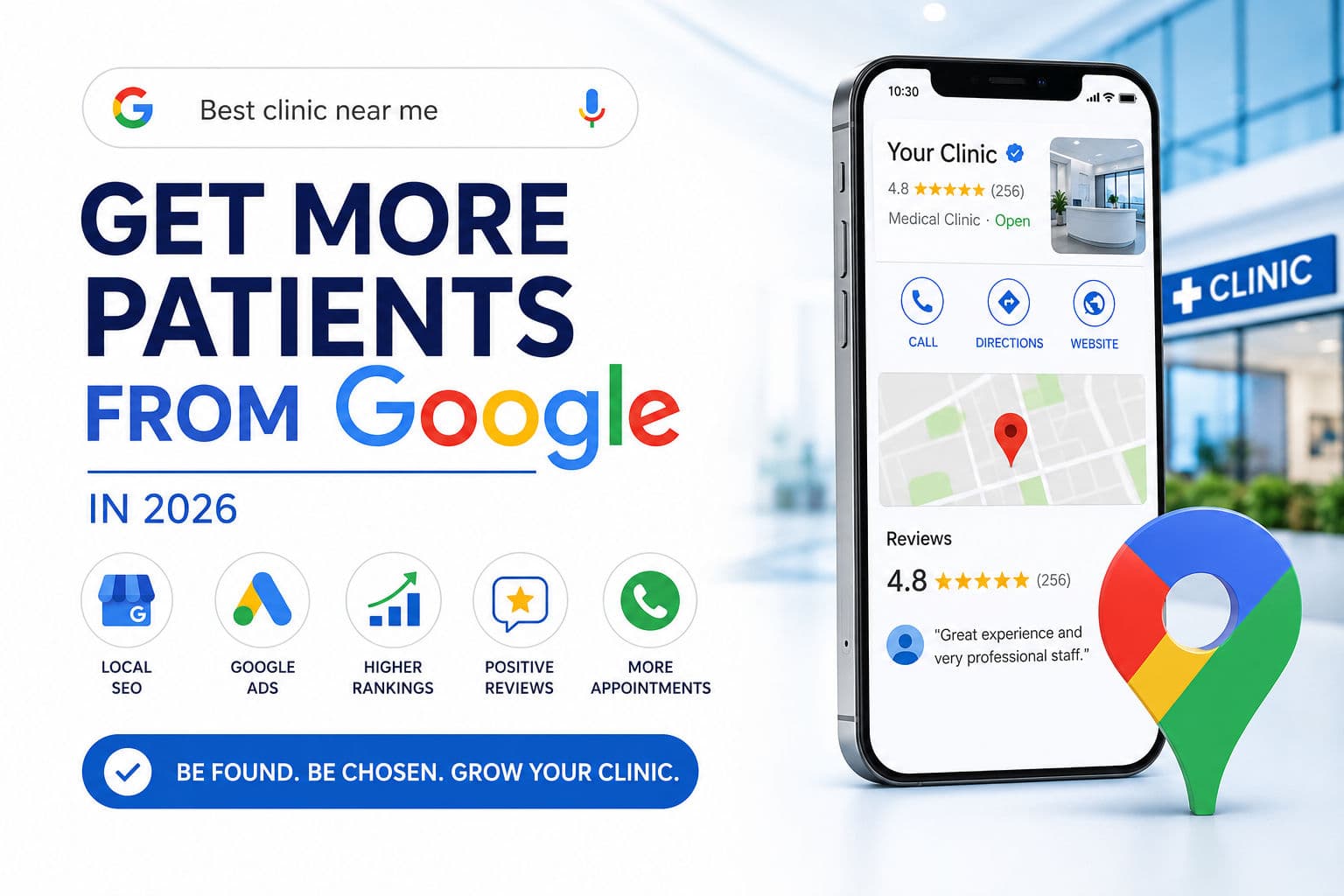
Your Google Business Profile is usually the first interaction a patient has with your clinic, and it directly controls how you appear on Google Search and Google Maps. Most clinics set it up once and abandon it, which is a problem: Google explicitly rewards profiles that stay complete, accurate, and active.
Add professional photos of your reception, doctors, consultation rooms, and facilities.
List every treatment and service you actually provide, not a generic category.
Keep hours, contact details, and appointment information current.
Respond to every review, positive or negative, professionally.
Post regular Google Business updates when you have something worth announcing.
Google's guidance is direct on this: complete and accurate business information helps customers find the right services and improves local search visibility. An incomplete profile isn't neutral — it actively works against you.
Layer 2: Google Ads — Reach Patients Who Are Already Looking
Most advertising interrupts people. Google Ads doesn't — it intercepts intent that already exists. When someone searches "dermatologist near me" or "best IVF clinic in Pune," they've already decided they need care. Your job is to be the answer at that exact moment, not to manufacture demand.
Healthcare campaigns that convert consistently share a few traits:
Search campaigns split by specialty and location, not one generic campaign for the whole clinic
A dedicated landing page per treatment or condition
Call tracking so you can measure which keywords actually produce enquiries
Mobile-friendly booking flows
Fast-loading pages with one clear appointment CTA
The single most common mistake clinics make is sending every paid click to the homepage. A patient searching "root canal treatment" should land on a page about root canals, not a generic site they have to dig through. Sending specific search intent to a generic page wastes the ad spend that got them there in the first place.
Layer 3: SEO — Build Visibility That Lasts
Ads stop producing the moment you stop paying. SEO doesn't work that way — it builds an asset that keeps generating visibility after the work is done. Where to focus:
Location pages
A dedicated page for every city or locality you actually serve, not one page trying to rank for all of them.
Treatment pages
Individual pages built around specific conditions and treatments, rather than one page that tries to cover everything your clinic does.
Educational content
Articles that answer real patient questions — causes of knee pain, when to see a dermatologist, signs you need physiotherapy — build topical authority while genuinely helping the reader.
Technical SEO
None of the above matters if the site is slow, broken on mobile, missing HTTPS, or full of dead links. Technical issues are usually invisible to the clinic owner and fatal to rankings.
Layer 4: Local SEO — Win the Map Pack
When someone searches "dentist near me," Google typically shows a small cluster of businesses with a map — often called the Local Pack or Map Pack — above the standard organic results. Appearing there drives a disproportionate share of calls and bookings relative to organic listings further down the page.
Google's local ranking factors — relevance, distance, and prominence — translate into concrete actions:
A fully completed Google Business Profile
Recent, positive patient reviews
Consistent Name, Address, and Phone Number (NAP) across every directory you appear in
Local relevance signals on your website itself
Overall online prominence — links, mentions, citations
Your clinic's details need to match exactly across Google Business Profile, Practo, Justdial, your website, and any other directory you're listed on. Inconsistent NAP data is one of the most common, and most fixable, reasons clinics underperform in the Map Pack.
Layer 5: Reviews — Build Trust Before the Phone Rings
Reviews aren't a nice-to-have add-on; they're a measurable factor in both trust and ranking. According to BrightLocal's 2026 Local Consumer Review Survey, 97% of consumers read reviews before choosing a local business — a near-universal behavior, not a niche one.
A patient comparing two clinics with similar services will almost always default to the one with more recent, credible, well-managed reviews. Clinics that win this don't leave it to chance:
Automated WhatsApp review request sent after every appointment
Feedback requested before the patient even leaves the building
Every review, including negative ones, gets a thoughtful response
Review collection runs continuously, not in bursts
This compounds: more reviews improve visibility, visibility brings more patients, and more patients create the next round of reviews.
What a working patient acquisition system looks like: A patient searches "knee pain specialist near me." Your clinic appears in Maps and Search. They see strong reviews, accurate details, and real photos. They land on a dedicated treatment page, not the homepage. They find a clear way to book. Your team responds fast. Each step removes one point of friction — and friction is where patients drop off.
The Bottom Line
Growing a clinic on Google was never a choice between SEO, Google Ads, or Google Business Profile — it's about whether all five layers are working as one system. A clinic that's easy to find, easy to trust, and easy to contact wins the patient, regardless of which channel brought them there first.
Frequently Asked Questions
How do I get more patients from Google?
Clinics get more patients from Google by combining a complete Google Business Profile, targeted Google Ads campaigns, ongoing SEO, strong Local SEO consistency, and active review management. Each layer addresses a different part of the patient journey, from discovery to trust to conversion, and works best when all five run together rather than in isolation.
What is the fastest way to increase clinic visibility on Google?
Google Ads is the fastest channel because it places your clinic in front of patients who are actively searching right now. A complete Google Business Profile is the fastest free improvement, since incomplete profiles are far less likely to surface in local search results.
Do Google reviews really affect clinic rankings?
Yes. Reviews are a core input into prominence, one of Google's three local ranking factors, alongside relevance and distance. According to BrightLocal's 2026 Local Consumer Review Survey, 97% of consumers read reviews before choosing a local business, making reviews both a ranking signal and a trust signal.
How long does clinic SEO take to show results?
SEO typically takes several months to build meaningful organic visibility, since it depends on Google indexing, evaluating, and trusting new or updated content over time. Unlike paid ads, SEO results compound and continue generating enquiries without ongoing per-click cost once pages rank.
What is the Google Maps Local Pack?
The Local Pack, also called the Map Pack, is the small group of business listings Google displays with a map above the standard organic search results for local queries. Appearing here significantly increases calls, direction requests, and website visits for clinics.
Should a clinic use Google Ads or SEO first?
Most clinics benefit from running both simultaneously rather than choosing one. Google Ads generates enquiries immediately while SEO is still building authority, and SEO eventually reduces dependence on paid spend by generating organic traffic that continues without ongoing ad costs.
Sources
Google Business Profile Help, "How Google determines local ranking" — support.google.com/business/answer/7091
BrightLocal, "Local Consumer Review Survey 2026" — brightlocal.com/research/local-consumer-review-survey
GrowClinic Editorial Team
GrowClinic (growclinic.io) is a healthcare-focused digital marketing agency working with clinics, dentists, dermatologists, and aesthetic practitioners across major Indian metros on SEO, Google Ads, and local visibility.
See Where Your Clinic Actually Stands
Most clinics invest in marketing without first knowing what's actually limiting their visibility. The GrowClinic Audit Tool gives you a free, 2-minute snapshot of your Google visibility, website conversion gaps, Google Business Profile issues, and where competitors are beating you — no forms, no obligation.


